How Operational Intelligence Is Transforming Healthcare Technology Management
Healthcare Technology Management (HTM) and Clinical Engineering are evolving from a maintenance function into a strategic driver of hospital performance. As medical devices become more connected and healthcare operations increasingly depend on real-time technology, hospitals need more than asset visibility. They need the ability to transform operational data into coordinated action. This shift is creating a connected healthcare technology ecosystem that requires new capabilities for prediction, prioritization, guidance, coordination, automation, and continuous optimization.
The pressure on HTM teams continues to grow. Connected medical devices, software management, cybersecurity, and regulatory requirements have expanded the scope of healthcare technology operations, while the U.S. Bureau of Labor Statistics projects employment of biomedical equipment technicians to grow through 2033. As responsibilities increase, healthcare organizations must find new ways to help highly skilled teams work more efficiently, make faster decisions, and coordinate increasingly complex technology environments.
For decades, Healthcare Technology Management (HTM) has focused on a fundamental mission: ensuring medical equipment is safe, available, and performing as expected. As hospitals expanded their technology footprints, they invested in computerized maintenance management systems (CMMS), asset tracking solutions, connected medical devices, cybersecurity tools, and dashboards to improve visibility into increasingly complex environments.
Those investments delivered valuable insight. But insight alone is no longer enough.
Today’s hospitals don’t struggle because they lack information. They struggle because they generate more operational data than people can reasonably interpret or act upon. Every service request, equipment alert, cybersecurity vulnerability, inventory shortage, software update, and utilization pattern creates another signal demanding attention.
The result is familiar to healthcare leaders.
Technicians spend valuable time coordinating work instead of completing it. Clinical departments experience delays while equipment availability is verified. Cybersecurity priorities compete with maintenance schedules. Capital planning decisions rely on fragmented operational data spread across multiple systems.
The challenge isn’t visibility.
The challenge is turning visibility into coordinated action.
That’s why Healthcare Technology Management is entering its next evolution. Leading organizations are moving beyond reactive maintenance and disconnected workflows toward what we call Intelligent HTM—an operating model that transforms operational data into faster decisions, coordinated execution, and continuously improving performance.
Understanding the Framework
Intelligent Healthcare Technology Management (HTM) is an operating model that transforms operational data into coordinated action. Rather than focusing solely on equipment maintenance, Intelligent HTM helps healthcare organizations anticipate issues, prioritize work, guide technicians, coordinate workflows, automate routine tasks, and continuously optimize performance.
Those six capabilities include:
1. Predict
2. Prioritize
3. Guide
4. Coordinate
5. Automate
6. Optimize
Together, these six capabilities form the Intelligent Healthcare Technology Management Framework. A connected operating model that transforms operational data into coordinated action, enabling healthcare organizations to make better decisions, improve execution, and continuously optimize performance.
Organizations leading the next era of healthcare technology management will share six defining capabilities. Together, these capabilities form the Intelligent Healthcare Technology Management Framework, a practical model for transforming operational data into coordinated action across a connected healthcare technology ecosystem.
Each capability builds on the one before it. Organizations first learn to anticipate operational issues, then prioritize work, guide decision-making, coordinate workflows, automate execution, and continuously optimize performance.
Predict
See what’s next before it impacts patient care
In a connected healthcare technology ecosystem, predicting operational risk is more valuable than simply reacting to equipment failures.
Traditional maintenance has largely been reactive. Even preventive maintenance follows predetermined schedules rather than the actual condition or behavior of equipment.
Modern healthcare environments require something more dynamic.
Every connected medical device generates operational signals—from service history and utilization patterns to performance trends and environmental conditions. When those signals are analyzed together, organizations gain the ability to identify emerging risks before they interrupt clinical care.
Prediction is about more than preventing equipment failures.
It reveals where service demand is increasing, which assets are showing early signs of degradation, and where operational patterns suggest larger workflow issues may exist. Instead of reacting to downtime, HTM teams begin preventing disruption before clinicians experience it.
As healthcare technology becomes increasingly connected, predictive intelligence becomes the foundation for more resilient operations.
Prioritize
Stop treating every work order like it matters equally
Every healthcare organization has more work than available resources.
The question is no longer, What needs attention?
It’s What matters most right now?
Traditional service models often treat work requests similarly, relying on first-in, first-out queues or manual assessment. But operational reality is far more nuanced. A routine repair in one department may have little impact on patient care, while a similar issue in a high-volume procedural area can quickly disrupt clinical operations.
True prioritization requires understanding context.
- Clinical impact
- Operational risk
- Equipment criticality
- Cybersecurity exposure
- Staff availability
- Patient demand
When organizations evaluate these factors together rather than independently, they allocate resources where they create the greatest value—not simply where requests arrived first.
The result is better decisions, faster response, and greater confidence across the organization.
Guide
Put the right expertise in front of every technician
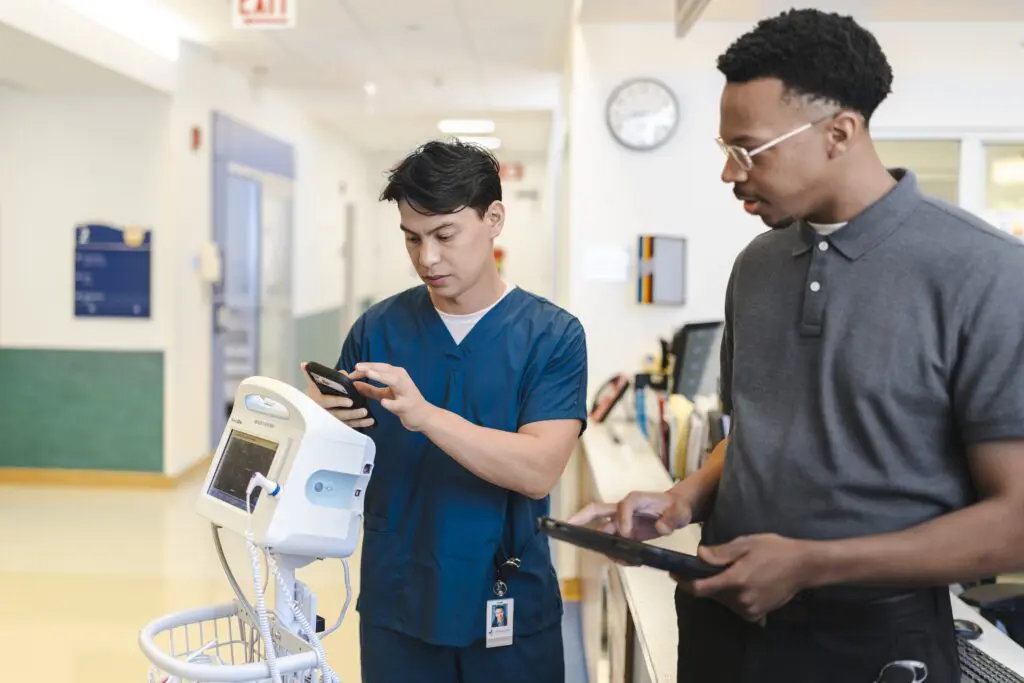
As healthcare technology becomes more complex, technicians are expected to support a growing mix of medical devices, manufacturers, software versions, and regulatory requirements. Finding the right information at the right moment can be as important as having the right tools.
High-performing HTM and clinical engineering teams are moving beyond static documentation and disconnected knowledge repositories. Instead, they are providing technicians with AI-assisted guidance that brings together OEM recommendations, service history, organizational best practices, and operational context within the workflow itself.
Rather than searching manuals or relying solely on institutional memory, technicians receive timely, context-aware recommendations that help them diagnose issues faster, perform repairs more consistently, and make informed decisions in the field.
Guidance isn’t about replacing technical expertise. It’s about augmenting it—making decades of service knowledge available to every technician, at every facility, every time they need it.
When organizations can consistently guide decision-making with trusted information, they reduce variation, accelerate onboarding, improve first-time fix rates, and deliver more reliable service across the enterprise.
Coordinate
Break down the silos slowing healthcare technology operations
Healthcare technology is no longer a collection of individual assets. It has become a connected ecosystem of medical devices, clinical systems, service operations, cybersecurity, inventory, workflows, and people.
Clinical engineering, HTM, IT, cybersecurity, supply chain, facilities, nursing, and executive leadership all influence how technology performs across the hospital.
Unfortunately, many organizations still manage these functions through disconnected systems and independent workflows.
The result is unnecessary friction. Information is duplicated.
Work is delayed. Priorities conflict.
Operational intelligence depends on coordination. Service requests, inventory, cybersecurity events, asset availability, lifecycle planning, and maintenance activities must function as part of a connected operating model rather than independent processes.
When every stakeholder shares the same operational picture, organizations respond faster, collaborate more effectively, and reduce the delays that occur when information remains siloed.
Technology operations become an enterprise capability instead of a collection of departmental responsibilities.
Automate
Automate coordination not human expertise
Discussions about artificial intelligence often center on automation replacing people.
Healthcare presents a different opportunity.
The greatest value comes from removing repetitive coordination work—not replacing skilled professionals.
Highly trained technicians shouldn’t spend their time manually routing work orders, searching multiple systems for equipment history, coordinating parts, or determining which request deserves attention first.
Automation handles those repetitive decisions. Scheduling becomes dynamic. Routing adapts automatically. Inventory coordination accelerates. Workflows adjust as operational priorities change.
The outcome isn’t fewer people. It’s enabling experienced professionals to spend more of their time applying the judgment, creativity, and technical expertise that technology cannot replace.
Automation should elevate people. Not compete with them.
Optimize
Turn every service event into a smarter operational decision
Operational intelligence doesn’t end when a repair is completed.
Every maintenance event generates information. Every work order reveals another operational pattern. Every technician interaction contributes new knowledge about equipment performance, workflow efficiency, and organizational priorities.
Leading healthcare organizations continuously learn from these interactions. Scheduling improves. Capital planning becomes more informed. Recurring failures are identified earlier. Resources are allocated more effectively. Operational performance strengthens over time.
HTM evolves from maintaining equipment to continuously improving how technology supports patient care. The organization becomes smarter with every decision it makes. That is the defining characteristic of Intelligent HTM.
From Intelligent HTM to Intelligent Healthcare Operations
Healthcare technology management is no longer a collection of individual assets. It is an interconnected ecosystem that influences clinical performance, operational efficiency, cybersecurity resilience, financial stewardship, and the patient experience.
Managing that ecosystem requires more than visibility.
It requires prediction, intelligent prioritization, shared expertise, coordinated execution, automation, and continuous optimization.
Together, these six capabilities form what we believe is the future of Healthcare Technology Management.
Organizations that embrace this operating framework will make faster decisions, reduce operational friction, strengthen clinical performance, and create more resilient healthcare systems.
How Intelas Brings Intelligent HTM to Life
Frameworks only create value when organizations can operationalize them consistently across people, processes, and technology.
For more than 30 years, Intelas has partnered with healthcare organizations to improve the performance, reliability, and resilience of their technology operations. That experience has shaped our perspective on where HTM is headed—and inspired us to build technology that supports this next generation of operational excellence.
NexCORE AI operationalizes these six capabilities by connecting service delivery, asset intelligence, workflow orchestration, cybersecurity, inventory, and lifecycle management into a single healthcare technology operating environment.
Rather than functioning as another system of record, NexCORE AI serves as an operational intelligence and workflow orchestration platform that connects service delivery, asset performance, cybersecurity intelligence, inventory, lifecycle management, and operational workflows into a single connected environment.
It helps Clinical Engineering, HTM, and healthcare operations teams move beyond simply monitoring technology to intelligently orchestrating how technology is managed across the system.
The result is a healthcare technology operation that doesn’t just respond to change. It anticipates it, coordinates it, and continuously improves because of it.
At Intelas, we believe the future of HTM isn’t defined by repairing equipment faster. It’s defined by enabling hospitals to make better decisions powered by intelligence, connected through workflows, and focused on delivering better outcomes for clinicians, caregivers, and patients.
Healthcare Technology Management (HTM)
What is Healthcare Technology Management (HTM)?
Healthcare Technology Management (HTM) is the discipline responsible for ensuring medical equipment is safe, reliable, available, and operating effectively throughout its lifecycle. Traditionally focused on equipment maintenance and regulatory compliance, HTM has evolved into a strategic function that supports clinical operations, cybersecurity, capital planning, and hospital performance. High performing HTM solutions like Intelas combine asset management, service delivery, operational intelligence, and workflow coordination to help healthcare organizations maximize the value of their technology investments.
How does Intelas improve medical equipment uptime?
Intelas improves medical equipment uptime through proactive maintenance, standardized service delivery, real-time asset visibility, and AI-driven operational intelligence. Clinicians can quickly request equipment and view service status through the TechCONNECT mobile experience, while technicians receive AI-assisted guidance and prioritized workflows to resolve issues faster. Together, these capabilities help maximize equipment availability and keep critical devices ready for patient care.
Can Intelas help reduce healthcare technology costs?
Intelas reduces healthcare technology management costs by improving equipment utilization, increasing technician productivity, reducing unnecessary rentals and capital purchases, optimizing service delivery, and extending asset life. By combining onsite expert HTM services with connected technologies and operational intelligence, organizations gain greater visibility into their equipment, workforce, and workflows, helping control costs while maintaining high levels of performance and reliability.
Why is Healthcare Technology Management important?
Healthcare technology management directly influences patient care, clinician productivity, operational efficiency, and financial performance. Effective HTM helps reduce equipment downtime, improve asset utilization, support regulatory compliance, strengthen cybersecurity readiness, and inform smarter capital planning decisions. As hospitals become more dependent on connected medical devices, HTM plays an increasingly important role in overall hospital operations.
How does Intelas use artificial intelligence to improve Healthcare Technology Management?
Intelas uses artificial intelligence (AI) to help healthcare technology management (HTM) teams analyze operational data, identify emerging risks, prioritize work, guide technicians with context-aware recommendations, automate routine workflows, and continuously optimize service delivery. Rather than replacing technicians, AI enhances human expertise by delivering operational intelligence that helps teams make faster, more informed decisions and improve the performance of healthcare technology operations.
What is Intelas' healthcare technology ecosystem?
Intelas’ technology ecosystem is an integrated operating environment where medical devices, clinical systems, service operations, cybersecurity, inventory, and lifecycle management are connected through shared data and coordinated workflows. Our fully integrated and connected approach enables hospitals to improve equipment availability, reduce operational friction, strengthen collaboration, and make better decisions across the enterprise.